Best Red Light Therapy Devices for Home 2026: Evidence Informed Guide from a Registered Nurse (Not a Magic Number)
Red light therapy has gained significant popularity for its potential benefits in skin longevity, pain management, recovery, and overall wellness. As a registered nurse with 17 years of nursing experience, I’ve seen how inflammation, slow healing, and daily stress take a toll on the body.

To be honest, when I first heard about red light therapy years ago, I knew almost nothing about it and was skeptical. I thought it might be more of a gimmick than a real therapeutic option. But as I started reading the research, I was genuinely surprised by the abundance of studies supporting its benefits — from improved collagen production and skin health to reduced inflammation, pain modulation, and support for tissue repair.
That research changed my perspective. Today, I’m passionate about educating people so they can actually benefit from red light therapy instead of wasting money on poor-quality devices that ride the popularity wave but deliver little to no real results. My goal with this guide is simple: help you understand the science, recognize what truly matters when choosing a device, and make informed decisions based on your specific needs.
What Are the Key Benefits of Red Light Therapy for Home Use?
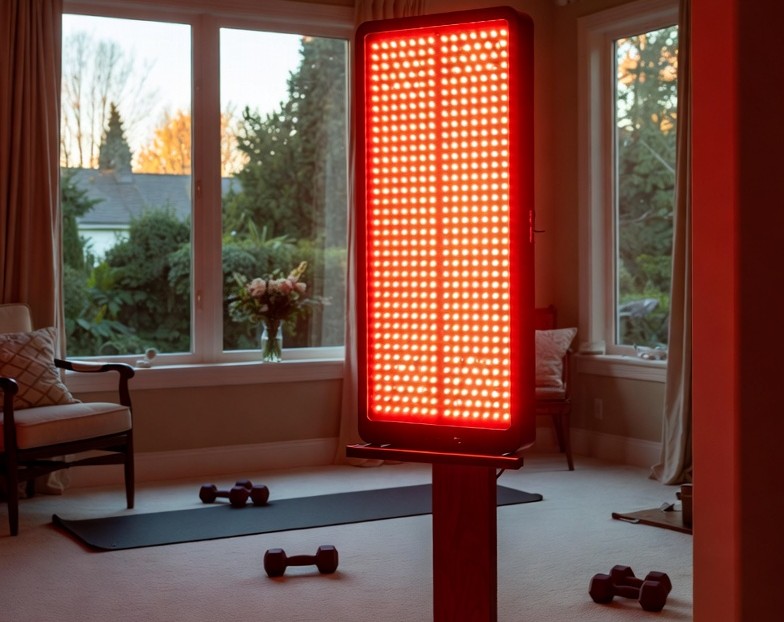
At-home red light therapy devices use photobiomodulation, the process where specific light wavelengths interact with cells, and can support several practical wellness goals:
- Support for Skin Health and Longevity: Red and near-infrared light may help stimulate collagen production, improve skin elasticity, and enhance overall tone and texture.
- Potential Reduction in Inflammation and Discomfort: It may help modulate inflammatory responses and ease muscle soreness or joint discomfort.
- Support for Recovery Processes: By supporting cellular energy production, red light can aid the body’s natural repair mechanisms after minor injuries or workouts.
- Convenience: Home devices make it easier to maintain a consistent routine.
- Non-Invasive Approach:It offers a drug-free option that many people find easy to integrate into daily life when used appropriately.
These benefits are most noticeable with consistent use as part of a broader recovery and wellness foundation.
How Does Photobiomodulation Work?
Think of photobiomodulation like giving your cells a gentle, targeted energy boost, similar to how a plant uses sunlight to power photosynthesis, but for human cells.
When red and near-infrared light reaches your skin and tissues, specific wavelengths are absorbed by mitochondria (the “power plants” inside your cells). This absorption stimulates the production of adenosine triphosphate (ATP) — the main energy currency your body uses for repair, regeneration, and daily function. At the same time, it helps reduce excess oxidative stress and inflammation that can slow healing.
Red light (typically in the 600–700 nm range and especially around 630 nm-660nm) acts more on superficial layers, such as the skin, supporting collagen production and improving tone and texture. Near-infrared light (780–850 nm) penetrates deeper into muscles, joints, and connective tissue, making it especially useful for recovery and pain relief. Many quality devices combine both wavelengths to provide benefits across multiple tissue depths.
In simple terms, red light therapy doesn’t “heal” you directly — it supports your body’s own natural repair processes by giving your cells the energy and conditions they need to work more efficiently.
More power is not the goal.
Photobiomodulation follows a two-phase dose curve. A low dose may do little. A moderate dose is where most of the useful research sits. A high dose can flatten the benefit and if the device also heats the skin, the session is no longer just a light signal. Heat has become part of the stimulus. Mild warmth is common and is not a reason to stop. Strong heat does not mean the device is working better. It can shorten the session, irritate the skin, or push the dose out of the useful window. Warm is fine. Hot means shorten the time or move the device farther away.
That is why I do not tell people "buy the highest power device you can afford.” I ask whether the wavelength is in the researched window, whether the session can reach a reasonable dose without burning, and whether the shape of the device matches the job — face, joint, or larger area.
The Nuance of Choosing the Right Red Light Therapy Device

One of the most important things to understand is that red light therapy isn’t one-size-fits-all, even among high-quality devices.
There is real nuance here. Different wavelengths, power outputs, coverage areas, and formats serve different goals. For example:
- If you’re dealing with knee pain or joint discomfort, you may benefit more from a targeted, deeper-penetrating device or a flexible wrap that can conform to the area.
- If your focus is collagen production, skin tone, and healthy skin aging (or skin longevity as I like to call it), a well-designed face mask or smaller panel with red wavelengths in the researched range often make more sense.
- For overall recovery after workouts, a larger full-body mat, targeted area device or a combination of devices can provide efficient coverage for larger muscle groups.
Even among reputable, high-quality options, there isn’t necessarily a single “best” device. The right choice depends on how you plan to use it, which areas you want to treat, and your lifestyle. A premium flexible wearable device like the Kineon Move+ Pro might be ideal for someone who wants portability and targeted relief, while a larger mat or specialized face panels could be better suited for full body benefits or consistent skin-focused routines.
At Longevity Studio, we carefully select a range of red light therapy devices because we believe the most effective tool is the one that matches your actual needs and that you’ll use consistently.
What Makes a Low-Quality Red Light Therapy Device?
Unfortunately, the popularity of red light therapy has led to many inexpensive devices that look similar on the surface but deliver very little benefit. Here are the most common red flags I recommend watching for:
- No named wavelengths, or wavelengths that do not match the label. If the company will not list nanometers, or a cheap LED claims 660 nm / 850 nm with nothing to back those claims up, that is a problem. The useful windows are roughly 600–700 nm for red and 780–850 nm for near-infrared.
- Output that is too weak for how the device is used. A panel used at 6–12 inches needs enough intensity at that distance. A mask or wearable sits on the skin, so it can use a lower published output and still deliver a useful session.“Below 20–30 mW/cm²” is a warning for panels at distance — not an automatic fail for every contact device.
- Uneven coverage. Bright in the center, dim at the edges, or obvious gaps between lights.
- High flicker or high EMF from cheap drivers. Flicker can bother eyes. High EMF is a build-quality issue, not a light-dose issue.
- Vague specs on cheap no-name devices. No wavelengths listed, no distance with the output number, or only words like “powerful” and “clinical.” Reputable brands sometimes publish wavelengths and build details without a full independent irradiance chart. That is just incomplete documentation — not the same as a $50 device from a drugstore or big name store that doesn't publish any numbers at all.
A missing irradiance chart does not mean the device is junk, and it does not mean I am asking you to ignore documentation. It means I have the wavelength and the shape, but not a measured output at a stated distance. I can still recommend it for regular home sessions when a reputable brand lists real nanometers and the device fits the body part. I will follow the manufacturer's session time and the simple rule that the skin should not get hot. What I will not do is tell you that this specific unit matches the joules in a published study. Incomplete output data limits how precise I can be. It does not cancel the wavelength research or make consistent use a bad idea.
What Are Good Specifications to Look For?
The two numbers that matter are irradiance and fluence. They work together. Neither one is a pass/fail score by itself.
- Irradiance (measured in mW/cm²) is how strong the light is at a stated distance. For panels, I want that number at 6–12 inches, not pressed against the LEDs. Many home protocols work in a broad band of about 10–100 mW/cm² at the skin. Higher output shortens the session. It does not automatically mean a better result, and very high output plus a long session can overshoot the useful window or overheat the skin.
-
Fluence (measured in J/cm²)
is the session dose: irradiance × time. Research protocols often land around 3–15 J/cm² for skin and 10–60 J/cm² for deeper muscle or joint work. A lower-irradiance contact device used for 10 minutes can reach the same fluence as a stronger panel used for 3 minutes.
Use the manufacturer’s distance. Warm is acceptable. Hot is a stop. Consistency (several sessions a week) matters as much as the peak number on the box.
Other helpful specs include third-party irradiance numbers when they exist, even coverage, low flicker, and clear documentation. Those details make a device easier to compare and easier to dose. They are not the same thing as the wavelength baseline.
In short, a low-quality device may glow red and feel warm, but it often fails the first test: real, named wavelengths in the researched windows. Education is how you avoid spending money on something that looks impressive and does very little.
How I actually judge a device
A quality red light device is not one number on a spec sheet. I look at three things together.
First, the wavelengths. Red in the 600–700 nm range and near-infrared in the 780–850 nm range are the bands most often used in photobiomodulation research. If a company will not name those numbers, I do not treat the device as a serious option.
Second, whether I can estimate dose. Irradiance at a stated distance lets me think about session energy the way a study does. When that chart is missing, the wavelengths can still be in the researched window. I simply cannot calculate a study-style dose. I will say so. I still recommend those devices for consistent home use when they fit the job. I just won’t claim it matches a specific study dose.
Third, the shape. A mask belongs on the face. A wrap belongs on a joint. A pad belongs on a shoulder or back. A panel covers a larger area at a set distance. The right type of device is what gets the light onto the area you care about, at a distance you will actually use, several times a week. A higher output panel that stays in the closet is not more useful than a simpler device you use on schedule. The same is true of a handheld device you forget to pick up versus a hands-free wrap or mask you can leave in place. Before you buy, match the type of device to how you will actually use it and your needs. Consistency with the device you chose matters more than a higher number on a spec sheet.
Cheap no-name products usually do not even list real wavelengths. That is an automatic NO. A reputable brand may skip a full irradiance chart and still use the right wavelengths in a shape that fits the job. That device can still be useful at home when the wavelengths and shape are right. I just won’t claim it matches a specific study dose.
I read the research so I can tell those two situations apart. That saves you from two mistakes: spending money on a cheap device with no real wavelengths, and walking away from a reputable device because one number is missing from the spec page. You get a device you will actually use, in the right wavelength range, without treating a single irradiance cutoff as the whole quality test.
Which Features Define the Best Home Red Light Therapy Devices?
When you compare devices, look for what you will use safely and consistently:
- Wavelengths. Red in the 600–700 nm range (especially around 630–660 nm) and near-infrared in the 780–850 nm range cover different tissue depths. Both together is useful. Red alone is still valid for skin-focused devices.
- Output you can finish without heat. Higher irradiance can mean a shorter session. It does not automatically mean a better result. Warm is fine. Hot is a stop.
- Coverage and shape. A panel, pad, mask, or wrap should match the body part and spread light evenly.
- Ease of use. Simple controls, a timer, and clear session guidance are what make consistency possible.
The “best” home device is the one with researched wavelengths, a shape you will use several days a week, and output you can use without overheating the skin.
What Wavelengths Are Most Effective?
Research most often uses red light in the 600–700 nm range (especially around 630–633 nm and 660–670 nm) and near-infrared in the 780–850 nm range (especially around 810, 830, and 850 nm). These bands reach different depths, so a blend is useful when you want both skin-level and deeper coverage. 660 nm is inside the window, not outside it.
How Do Device Specifications Impact Therapy Outcomes?
The main factors are wavelength, irradiance at the distance you will use, session time, and even coverage. Power matters because it changes how long a session needs to be. It does not guarantee a better outcome by itself. A device you can use consistently, at a comfortable distance, with even light on the target area, is more useful than a higher output number you cannot apply well.
How Should You Use Red Light Therapy Safely at Home?

Recommended Usage Protocols for Best Results
- Start with shorter sessions (5–10 minutes) and gradually increase as tolerated.
-
; generally panels are often recommended at 6–12 inches; masks, wraps, and many pads are meant to be placed on or against the skin.
- Listen to your body: If you feel excessive warmth, discomfort, or irritation, stop the session. Move the panel farther back and increase the distance next time or shorten the time on a mask, wrap or pad.
- Use protective eyewear when treating areas near the face.
- Be consistent: Most research-supported protocols suggest 3–5 sessions per week. Consistency in use is one of the most important aspects of using red light therapy.
Pair it with other recovery practices like good sleep, movement, and nutrition for compounding effects.
Important Safety Note: Red light therapy is generally well-tolerated, but it’s not suitable for everyone. Avoid use if you have photosensitivity, take certain photosensitizing medications, or are pregnant without first consulting your healthcare provider.
Final Thoughts from Your RN at Longevity Studio
Red light therapy has real potential when used correctly, but its effectiveness depends heavily on choosing a quality device with appropriate specifications for your goals. After years of clinical experience and reviewing the research, I believe education is key so that people can reap genuine benefits instead of buying poor-quality products, that capitalize on popularity without delivering results.
This is not an exhaustive list of every worthwhile device on the market. It is the collection I have reviewed and can actually offer; different types of devices for the face, joints, and larger areas so that you can match the device to how you will use it. I continue looking for products that meet that same standard, and the lineup will grow as I can bring them into Longevity Studio collections.
If this guide helped you better understand the science and what to look for, I invite you to explore the collection of red light therapy devices available at Longevity Studio. You’ll find thoughtfully selected options for the face, joints, and larger areas, so the device can match how you will actually use it.
Thank you for reading. Here’s to making informed choices that truly serve your health — one consistent step at a time.
Written by Longevity Studio Founder, RN
Insights for Transformative Living
References
- Shiyun Yi, et al. Efficacy and safety of 570/590 Nm yellow light combined with red light and infrared LED in treating facial skin photoaging: A Single-Center, randomized Controlled exp. study, Lasers Med Science, 2025.
- De Oliveira, et al. Low-intensity LASER and LED (photobiomodulation therapy) for pain control of the most common musculoskeletal conditions, European Journal of Physical amd Rehabilitation Medicine, 2022 Apr;58(2):282-289
- Hernández-Bule ML, et al. Unlocking the Power of Light on the Skin: A Comprehensive Review on Photobiomodulation. International Journal of Molecular Sciences. 2024;25(8):4483.
- Couturaud V, et al. Reverse skin aging signs by red light photobiomodulation. Skin Research and Technology. 2023;29(7):e13391.
- Spongberg CV, et al. What to Look for in Red Light Therapy: A Product Guide Backed by Science. Cureus. 2026;18(3):e105378.
- Syed SB, et al. Photobiomodulation therapy mitigates cardiovascular aging and improves survival. Lasers in Surgery and Medicine. 2023;55(3):278-293.
Medical & Health Disclaimer:The information provided in this blog post (including any discussions of health optimization, longevity tools, contrast therapy, PEMF, infrared red saunas, cold plunges, hyperbaric chambers and other wellness practices and protocols) is for general educational and informational purposes only. It is not intended to be, and should not be considered medical advice, diagnosis, treatment, or a substitute for professional healthcare guidance. As a registered nurse, I share insights based on available research and general knowledge, but this content does not constitute the practice of medicine, nursing, or any other professional health service. No doctor-patient or nurse-patient relationship is formed by reading this post or interacting with Longevity Studio. Always consult your physician, qualified healthcare provider, or other licensed professional before starting any new wellness practice, exercise program, therapy, or using any device/product mentioned here, especially if you have pre-existing medical conditions, are pregnant or take medications. Never disregard professional medical advice or delay seeking it because of something you read here. Longevity Studio and its staff/content creators are not liable for any actions taken based on this information. Individual results may vary and not all practices or tools are suitable for everyone.