
Article: Does Your Sleep Feel Off in the Fall? Why Blue Light Blocking Glasses Can Support Circadian Rhythm and Sleep
Does Your Sleep Feel Off in the Fall? Why Blue Light Blocking Glasses Can Support Circadian Rhythm and Sleep
You know that stretch of evenings in late September when the house feels wrong and you cannot name why? Dinner is fine. Then after dark you are tired in your body and wired in your head. The phone is still bright. The kitchen LEDs are still on. You finally get to bed and your brain is still going.
Here is what changed. After the fall equinox the sun leaves earlier, and the lights we live under do not. Overhead LEDs, laptops, TVs, and phones keep sending your brain a daytime signal long after the sky has gone dark. That is not a small lifestyle inconvenience. Light is one of the oldest signals your body has, from the warmth of the sun on your skin to the fact that you can see this page. Your internal clock uses that signal every day to decide when to be awake and when to repair.
I live with the same evening challenges as you do. Some nights the kids’ bedtime routine runs long, then I have to clean up after dinner and end with my laptop or phone scrolling. Other nights it is a long workday that never really ends, the kind a lot of men and women know too well; under bright fluorescent lights at the office all day, get home late, turn on all the bright lights in the house to continue some more work at a desk or on a laptop after dinner. Either way, your eyes cannot tell the difference between “I still have things to finish” and “it is still noon.”
This post is about the light already in your house, why it gets more disruptive after September 22, and how I use Ra Optics Daylight lenses during the day and Sunset lenses after sundown so artificial light is not wrecking the cues your sleep-wake cycle depends on.
What is a Circadian Rhythm, and why does blue light sit at the center of it?
Your circadian rhythm is an internal 24-hour schedule that syncs your body to the outside world. It does not only decide when you sleep. Sleep is the output most people notice first, but it drives essential internal processes like hormone production, neurotransmitters, metabolic activity, thirst, waste clearance, appetite/metabolism, alertness, and overnight cellular repair. When evening light knocks that schedule later, the cues those processes depend on arrive late too — melatonin rises later, sleep onset shifts later, and overnight repair gets a shorter window.
Blue light is the slice of natural sunlight that sets that clock. Morning sunlight is rich in it, and that tells your body, “day has started, be alert, make energy, run the daytime program.” As the sun drops, the blue fades out of the light. The same clock gets the opposite message: wind down, release melatonin, let the night program take over. Every living thing has a version of this rhythm, and it resets itself daily using the changing blue content of sunlight.
That is why evening artificial light is such a problem. Screens and modern LEDs are loaded with the same blue wavelengths your internal clock reads as “still daytime.” Sunlight also carries a large amount of near-infrared light that rides along with the blue. Most indoor bulbs strip that near-infrared out to be more energy-efficient, which leaves you with stimulating blue and far less of the balancing longer wavelengths found in actual daylight. So after sunset your body can keep running the day program; hormones stay in daytime mode, melatonin gets held back, and sleep arrives late and light.
What happens to your body clock when days get shorter?
The 2026 fall equinox in the Northern Hemisphere lands on the evening of September 22. Day and night are briefly close to even. Then dusk starts arriving earlier every week.
Your internal clock does not read a calendar. A special set of cells in the retina (the light-sensing tissue at the back of the eye), pick up incoming light (photons), and send that signal to a tiny pacemaker in the brain called the suprachiasmatic nucleus (SCN). That pacemaker talks to the pineal gland, which releases melatonin in response to darkness. Melatonin is not a sleeping pill. It is the hormone released in darkness that tells the brain night has started, lowers alertness, slows metabolic activity and opens the window for sleep and overnight repair.

Outdoors, that chain used to take care of itself. Bright, full-spectrum light during the day. Darkness at night. As we head past the equinox and into the end of daylight saving time, that contrast collapses. Suddenly, you're leaving work in the dark and walking into a home artificially lit up like it is still daytime. To your internal clock that looks like a long, strange day with no proper night.
People describe it as:
- Tiredness at dinner,
- A second wind once the house is fully lit
- Taking forever to fall asleep
- Waking groggy no matter how many hours they were in bed
That pattern is common when the light signal changes. That signal going into your eyes is what your body follows.
Why evening artificial light is harder on you than it looks
Light at night is not just “harsh on the eyes.” It is a timing cue. Those retinal light-meter cells are especially sensitive to the short-wavelength blue and green light that LEDs and screens put out. When they stay switched on after dark, the pacemaker keeps the “stay alert” pathway running and can slow the rise of melatonin. If that night message is late, sleep timing, next-day alertness, and how settled you feel in the evening can all run late with it.
In 2017 the Nobel Prize in Medicine went to the researchers who mapped the molecular machinery behind this clock. The headline is simple: light is the primary driver. A day is one rotation of the Earth, and the biggest environmental change in that rotation is the shift between light and darkness. When blue light keeps hitting your eyes after sunset, it tells the clock the day is still going. Sleep is one of the highest-leverage inputs you have for health and longevity. When evening light holds melatonin back, you do not just “feel off.” You get a shorter, lighter night, a flatter next day, and a hormone signal that never quite matches the hour on the wall. Over time that circadian drift is one of the ways sleep debt and recovery debt stack up. Sitting under noon-bright LEDs after sundown is working against you. The equinox just makes the mismatch obvious because the sun stops covering for us.
Should you wear blue light glasses during the day or only at night?

Both — but not the same lens. Daytime and nighttime are different jobs for your eyes and your clock. Wearing the wrong lens at the wrong time works against the benefit you are trying to get.
The pigments in Ra Optics lenses absorb high-energy blue light the way melanin in your skin absorbs UV — before it reaches the cells underneath. Daylight and Sunset use that same idea at two different strengths.
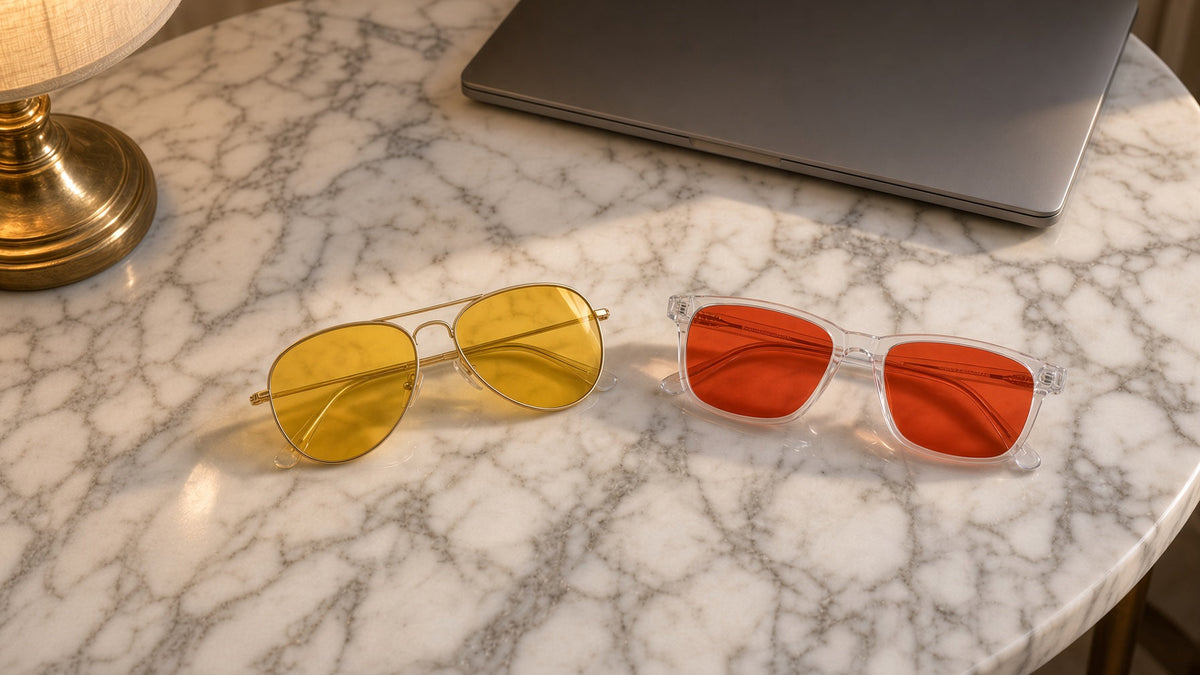
Ra Optics Daylight lenses are the daytime pair. Wear them when you are under office light, kitchen LEDs, or screens and you still need to think, see color clearly, and stay present. They take the edge off the harshest artificial wavelengths without turning the world orange.

Ra Optics Sunset lenses are the evening pair. They are the heavier filter. Blue and green light that would otherwise keep your brain in go-mode is filtered out from sunset until bedtime while wearing the glasses ( recommended for at least the last three hours before sleep). On Ra Optics’ own product pages, verified buyers describe falling asleep unusually fast once they started wearing Sunset lenses, including reports of being out in about 15 minutes or less, when that was not their norm. That is customer experience, not a guaranteed stopwatch. It does line up with the research, though: less evening short-wavelength light means melatonin is less likely to get held back, so the cue to fall asleep — and stay asleep — is less likely to get disrupted.

Your internal clock needs a strong daytime cue and a protected night. Sunset lenses all day flatten that daytime signal and can leave you drowsy when you still need to work. Daylight lenses after dark take some strain off the eyes, but they are not built as a full evening filter. Treat them as a two-lens rhythm: Daylight while the goal is clarity and daytime energy; Sunset once the sun is down and you want sleep timing protected.
A cheap pair of white-lens blue light glasses with a weak filter can make people think “blue blockers don’t work.” Lens strength and when you wear them both matter.
I am saving the deeper dive on Ra Optics lens technology and the research behind the pigments for a follow-up blog post, coming soon. This one is about timing: which lens, and when, after the equinox.
Who feels this shift the most?
- Anyone whose night still looks like a workday
- People who live on screens all day — office and remote work with long computer hours: answering emails, charting, studying, (or catching up on a laptop after dinner) etc.
- Parents who get a second shift after kids go down for bedtime and still have every light in the house on while finishing up household tasks and preparing for the next day
- Anyone who already sleeps lightly or experiences disrupted sleep, or notice September and October make you feel worse
- Households that turn on every bright overhead light the minute the sun drops
If you barely use screens after dinner, your bedroom is already dark and you have a solid and consistent bedtime routine that doesn't involve bright overhead lighting, then evening light is less of a problem for you. However, If your house stays brightly lit anytime after sundown, it applies whether that is 7 p.m, 10pm...anytime after sunset. Then I encourage you to examine your circadian rhythm and the role light plays on your internal processes and consider Ra Optics blue light blocking glasses.
What to do this week while the light is changing
Fall Equinox Light Routine
You do not have to wait until you buy a pair of blue light glasses to start offsetting what the equinox does to your evenings and your body. Morning sunlight and dimmer rooms after dark help immediately.
Morning. Step outside for 5–15 minutes after you wake up. Overcast counts. Do not stare at the sun. This is one of the strongest ways to set your internal clock so melatonin can show up on time at night.
Daytime. Get outdoor natutal light again if you can: a short walk, lunch outside, standing outside on a patio, etc. (Indoor light through a window is weaker than being outside). Even just a few minutes of sunlight will be better than staying indoors all day.
After sunset. If you can, step outside for a few minutes at dusk. That fading sunset light is the evening cue your biology is built for — not the bright overhead LEDs waiting inside. After your sunset light exposure, try to limit evening lights, dim the ones needed if possible. Warm lamps and candlelight beat bright overheads. Put your phone on the lowest brightness and night mode, and keep it at a distance not right up against your face. Turn off extra screens you are not using.
You do not have to live in the dark. You do have to stop telling your brain it is still daytime after the sun is gone.
Bring the Evening Back
The equinox did not break your sleep. The sun just leaves earlier, and the lights in the house keep saying daytime. Before modern homes with modern LED lighting, the evening cue was sunset and then firelight — warm, dim, and done. Overhead LEDs and screens after dark are a different disruptive signal.
The equinox is when it gets loudest, but the same mismatch happens every evening of the year — and again in March when daylight saving time shifts the clock
If your sleep is already sliding this September, you don't need to change your workload, you just need to change your light.

If you are ready to fix your light environment, start with your biggest problem area:
- The Daytime Eye Strain: If you work under harsh fluorescent office overheads and stare at screens all day, leaving your eyes feeling strained, a Daylight lens can help shield your system.
- The Evening Restless: If your primary battle is winding down your brain after the sun sets, staring at the ceiling waiting for sleep, or finding yourself trapped in a loop of late night TV binging and mindless scrolling, then a Sunset lens can help signal your body that it's time to rest and unwind.
But if this isn't new to you-if you've spent years grinding through long hours under artificial lights at work everyday, only to face endless tossing and turning in bed that leads to that late night binging TV or mindlessly scrolling on your phone; then fixing just one side of the equation leaves your sleep disrupted. Your biology is dealing with a two-part attack daily. Your brain doesn't even realize the sun went down and you can't afford to ignore it.
Aligning your environment with your natural circadian rhythm means addressing how to protect your eyes both under the office lights and after dusk. Ra Optics designs these frames to seamlessly bridge that gap, helping you manage the full spectrum of modern light without disrupting your health. You can pair a classic Daylight frame like Popp or JC with a dedicated Sunset frame like Clyde or Maxwell to give your body's internal clock the 24-hour support it needs to truly reset and regulate your sleep naturally.
Ra Optics has several premium, high quality frames in different styles to suit your individual taste. Explore the full lineup of Ra Optics blue light blocking glasses in our Wearable Tech Wellness collection.
FAQ
What is the difference between Ra Optics Daylight and Sunset lenses?
Daylight lenses are made for daytime indoor light — screens, LEDs, fluorescents — so you keep visual clarity while filtering the most disruptive artificial blue. Sunset lenses are made for evening. Ra Optics states they block 100% of blue light and most green light to support melatonin and the wind-down into sleep. That two-lens split matches the research: short-wavelength evening light is especially good at suppressing melatonin and delaying the body clock, so daytime and nighttime are different jobs.
Do Sunset lenses help people fall asleep faster?
Many Ra Optics customers say yes. Verified reviews on the manufacturer website include people who report falling asleep in under 15 minutes, or in just a few minutes, after they started wearing Sunset lenses in the evening — including one buyer who wrote they fell asleep on the couch within 15 minutes the first night, which “never happens.” Ra Optics also markets Sunset as helping you drift off faster. I treat those as real customer reports, not a promise that you will be asleep in 15 minutes. The evidence-based piece is the same one throughout this post: protecting your eyes from bright blue-green light after dark may support a more normal melatonin rise and an easier time falling asleep.
When should I wear Sunset lenses?
Ra Optics’ guidance is from sunset until bedtime, or at least three hours before you plan to sleep. Wear them anytime you are still under indoor lights or screens after the sun is down. That timing lines up with expert indoor-light recommendations and lab work on evening screens: after dusk is when light most easily holds melatonin back and pushes sleep later.
When should I wear Daylight lenses?
During the day whenever you are mainly under artificial light: office, kitchen, school, screens. Ra Optics also notes Daylight can be used in the evening if you want a lighter tint — late meals, social settings where color matters, nighttime driving, or as a step toward Sunset. For sleep protection after dark, they still treat Sunset as the stronger lens.
Can I wear Daylight lenses at night if I only own one pair?
Yes. Ra Optics says Daylight still gives meaningful blue-light protection at night. Sunset is the lens they engineered for evening, with deeper filtration for sleep timing. If you only have Daylight, wear them after sundown rather than sitting in unfiltered LEDs — then add Sunset when you can.
Can I wear Sunset lenses during the day?
You can, but it is not the main use. Ra Optics warns the heavier filter reduces light and color and can make you drowsy when you still need to be sharp. They list exceptions such as very intense indoor lighting or strong outdoor sun. For a normal workday, they point you to Daylight.
Do I still need morning outdoor light if I wear the glasses?
Yes. Ra Optics recommends unfiltered morning sunlight for about 10–20 minutes when you can get it. That sits on solid circadian research: morning outdoor light is one of the strongest ways to set your internal clock earlier, so evening melatonin can arrive on time. Daylight and Sunset manage artificial light. They do not replace sunrise on your eyes. Leave both pairs off for that short outdoor morning window.
Why do I feel tired earlier but wired after dark once the equinox hits?
Less outdoor sunlight during the day, more indoor light at night. Your clock is getting a weaker “day” signal and a stronger “still daytime” signal after dusk. That mix often feels like an early slump and a late second wind.
Do cheap blue light glasses do the same thing?
Usually not. Research shows melatonin is affected by specific short wavelengths — and by how bright and close the light is. Many cheap pairs are clear or only faintly tinted and filter very little of that band, so they do almost nothing for evening circadian light. Ra Optics’ position is that Daylight and Sunset pigments filter far more of that range than a generic white-lens pair. Lens color and strength matter more than the words “blue light” on the package.
Is this only for people who stay up late?
No. Ra Optics recommends wearing Sunset lenses when the sun goes down, and keep them on until bed — or at least the last three hours before sleep. If the lights and screens are on after dark, the evening job has started, whether that is 7 p.m. in October or later.
Where do I buy Ra Optics Daylight and Sunset lenses from Longevity Studio?
The wearable is here: Shop Ra Optics Daylight and Sunset Lenses
Written by Longevity Studio Founder, RN
17 years of clinical nursing experience. About Longevity Studio
Insights for Transformative Living
References
These papers informed the mechanisms in this article. They describe light, the retinal pathway to the body clock, melatonin, and circadian timing — not a clinical trial of any specific consumer frame.
- Berson DM, Dunn FA, Takao M. Phototransduction by retinal ganglion cells that set the circadian clock. Science. 2002;295(5557):1070-1073.
- Brainard GC, Hanifin JP, Greeson JM, et al. Action spectrum for melatonin regulation in humans: evidence for a novel circadian photoreceptor. J Neurosci. 2001;21(16):6405-6412.
- Thapan K, Arendt J, Skene DJ. An action spectrum for melatonin suppression: evidence for a novel non-rod, non-cone photoreceptor system in humans. J Physiol. 2001;535(Pt 1):261-267.
- Lockley SW, Brainard GC, Czeisler CA. High sensitivity of the human circadian melatonin rhythm to resetting by short wavelength light. J Clin Endocrinol Metab. 2003;88(9):4502-4505.
- Cajochen C, Münch M, Kobialka S, et al. High sensitivity of human melatonin, alertness, thermoregulation, and heart rate to short wavelength light. J Clin Endocrinol Metab. 2005;90(3):1311-1316.
- Gooley JJ, Rajaratnam SM, Brainard GC, Kronauer RE, Czeisler CA, Lockley SW. Spectral responses of the human circadian system depend on the irradiance and duration of exposure to light. Sci Transl Med. 2010;2(31):31ra33.
- Chang AM, Aeschbach D, Duffy JF, Czeisler CA. Evening use of light-emitting eReaders negatively affects sleep, circadian timing, and next-morning alertness. Proc Natl Acad Sci USA. 2015;112(4):1232-1237.
- Prayag AS, Najjar RP, Gronfier C. Melatonin suppression is exquisitely sensitive to light and primarily driven by melanopsin in humans. J Pineal Res. 2019;66(4):e12562.
- Brown TM, Brainard GC, Cajochen C, et al. Recommendations for daytime, evening, and nighttime indoor light exposure to best support physiology, sleep, and wakefulness in healthy adults. PLoS Biol. 2022;20(3):e3001571.
- St Hilaire MA, Ámundadóttir ML, Rahman SA, et al. The spectral sensitivity of human circadian phase resetting and melatonin suppression to light changes dynamically with light duration. Proc Natl Acad Sci USA. 2022;119(51):e2205301119.
- Wahl S, Engelhardt M, Schaupp P, Lappe C, Ivanov IV. The inner clock—Blue light sets the human rhythm. J Biophotonics. 2019;12(12):e201900102.
- CIE S 026/E:2018. CIE System for Metrology of Optical Radiation for ipRGC-Influenced Responses to Light. Vienna: Commission Internationale de l’Éclairage; 2018.
Medical & Health Disclaimer
The information in this post is for general educational purposes only. It is not medical advice, diagnosis, or treatment, and it does not create a nurse-patient relationship. Ra Optics lenses are wellness tools for managing indoor light exposure. They are not intended to diagnose, treat, cure, or prevent any disease, including eye disease, sleep disorders, depression, or metabolic disease. Always consult your physician before changing sleep practices or using new wellness products, especially if you have eye conditions, take photosensitizing medications, have a mood or sleep disorder, or work nights. Individual results vary.
Related reading

